
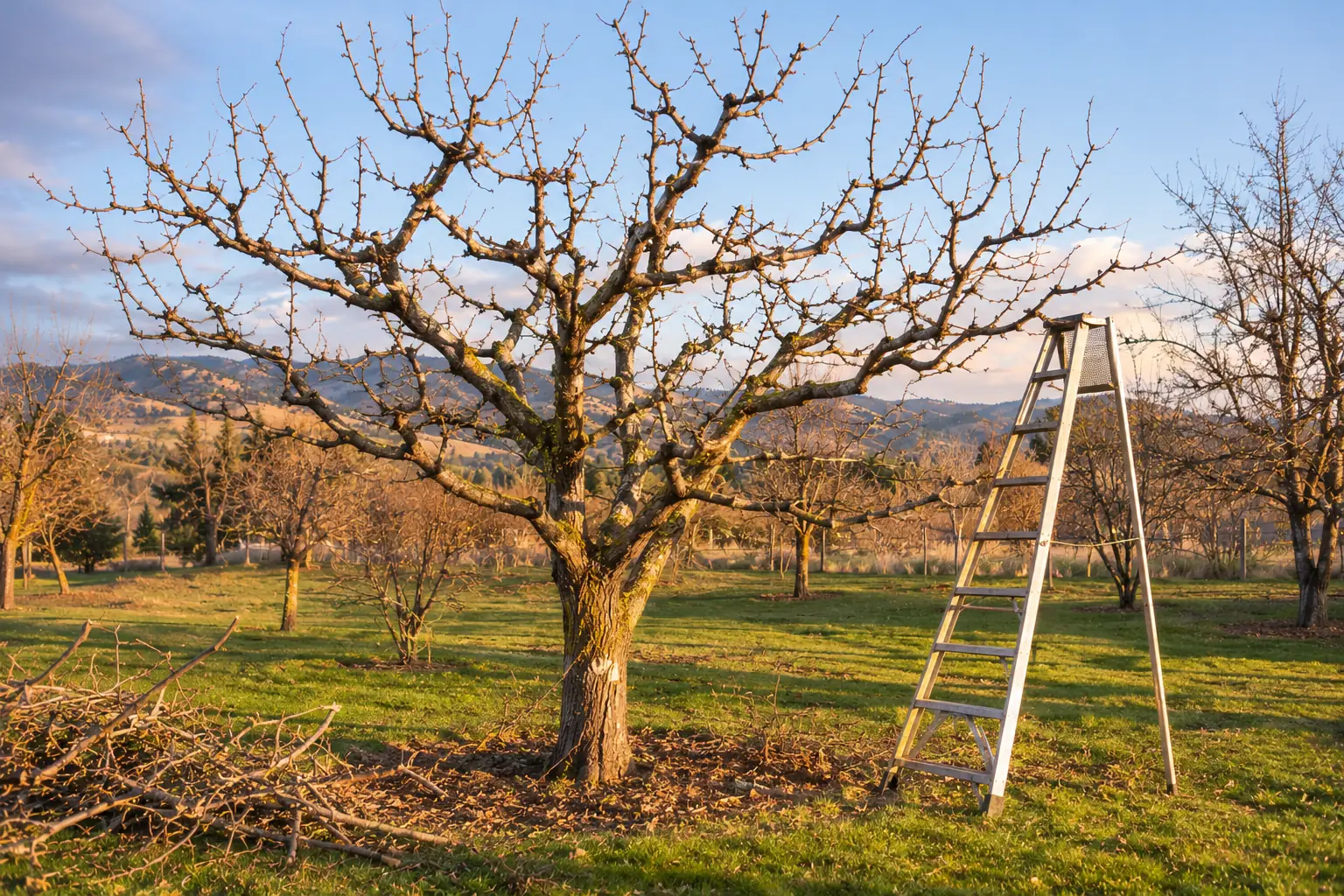
Fruit tree pruning in Medford is mostly late-winter work: once hard freezes are past and before buds break, a pruner thins and shortens branches so the tree carries fruit it can hold and lets light into the center. Sweet cherries are the exception. Call (541) 855-3179 to reach an independent local tree service, and ask whether it prunes home orchard trees.
Tree Services Medford is a referral service and does no pruning. A call to (541) 855-3179 goes to an independent Medford-area tree service with an active Oregon CCB license, which looks at your trees and quotes the job. This page explains why fruit trees need yearly cuts, when each common fruit should be pruned, the shapes pruners train trees into, how to handle fire blight on pears and apples, and what the work tends to cost. Every service the referral covers is on the home page.
Why fruit trees need yearly cuts
Fruit trees left alone grow tall, crowded crowns where the fruit forms high and out of reach, and many branches end up shaded. Regular pruning keeps fruit within reach, opens the tree to light and air, and removes wood that is dead or diseased.
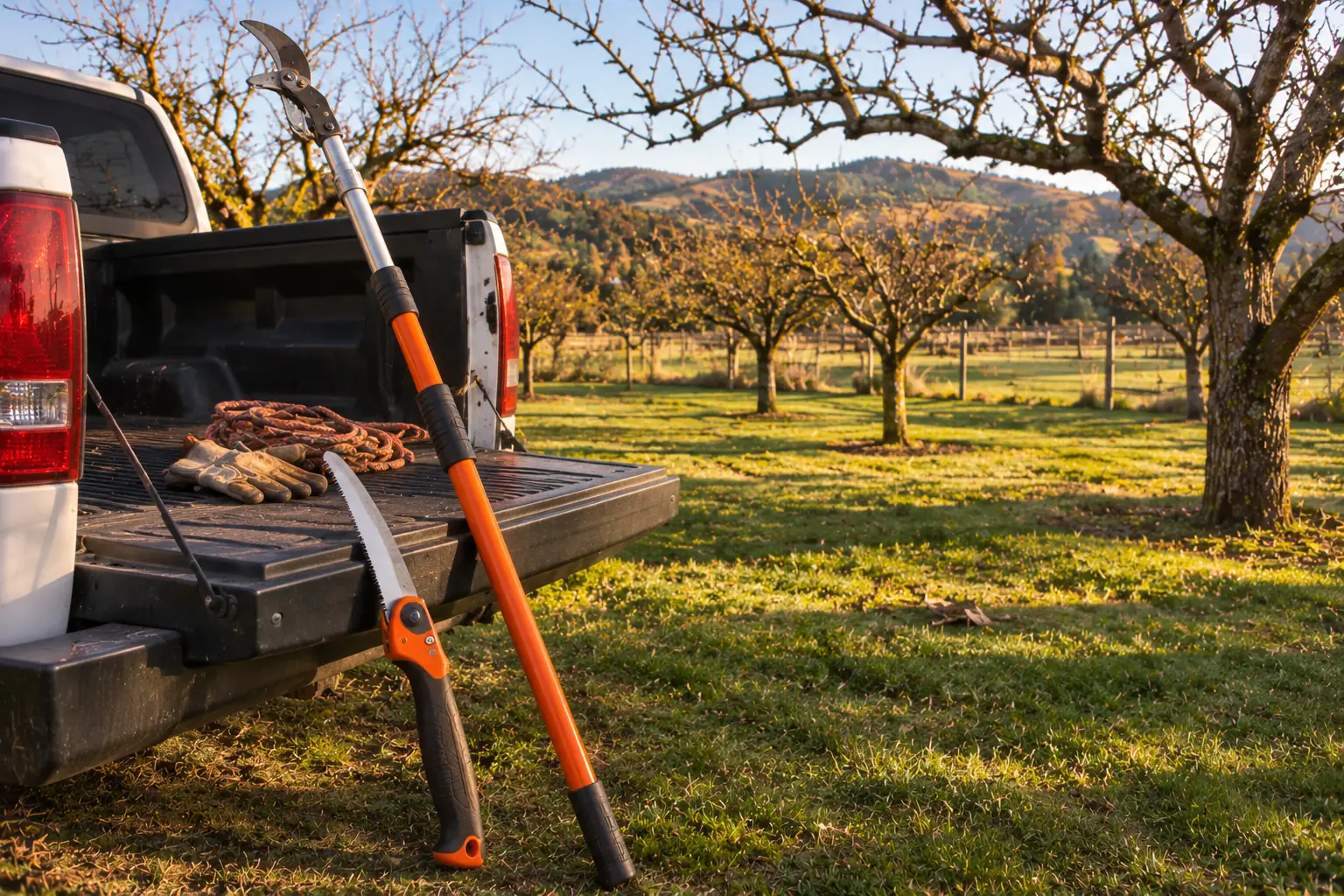
Oregon State University's home orchard guide lays out the basic reasons and methods (OSU Extension, PNW 400, Training and pruning your home orchard, revised February 2025). It also notes that untended trees can become sites for pests and diseases, so a neglected backyard tree is a problem for more than its own fruit.
When to prune each fruit in Medford
The general OSU rule is to prune after the danger of fall or early winter freeze has passed, but before growth starts in spring. In Medford that usually lands in late winter, but the weather each year sets the real date.
| Fruit | Usual timing | How it bears fruit | Notes from OSU guidance |
|---|---|---|---|
| Apple | Late winter, before buds open | On spurs, short stubby fruiting shoots | Trained to a central leader on many trees |
| Pear | Late winter, before buds open | On spurs | Grown with a central leader in the Pacific Northwest |
| Peach | Late winter, before growth starts | Only on 1-year-old shoots | Up to 50 percent of last season's growth removed each year |
| Sweet cherry | August is an option | On spurs | August pruning lowers the risk of bacterial infection |
| Plum | Late winter, before buds open | On spurs | Bears on spurs like apples and pears |
Because peaches bear only on 1-year-old wood, they need heavier pruning every year than apples or pears. Cutting off too many spurs on an apple or pear, on the other hand, removes next year's fruit. Ask your pruner to explain the plan for each kind of tree, rather than one cut for all.
The pruning calendar guide covers shade and ornamental trees too.
The shapes pruners train fruit trees into
Fruit trees are trained into a planned shape when young, and later pruning keeps that shape. The OSU guide describes two main systems:
- Central leader. One main upright trunk with layers of side branches spaced around it, wider at the bottom and narrower at the top. Pears and many apples are grown this way.
- Open center, or vase. No central trunk; three or four main limbs grow up and outward from a short trunk, leaving the middle open to sun. Peaches are trained to this shape.
If you bought a house with an orchard that was never trained, the trees may not fit either shape. Ask the company whether it can bring the trees back toward a workable form over more than one season, and what that would cost each year.
Heading cuts and thinning cuts
Pruners make two basic kinds of cuts, and the mix decides how the tree grows back. OSU's guide defines a heading cut as one that removes part of a branch along its length, and a thinning cut as one that removes an entire branch at its point of origin.
Heading cuts stiffen limbs and push the tree to branch. Thinning cuts let limbs grow long and flexible, so they bend down when loaded with fruit. Too many heading cuts give you a thicket of new shoots; a skilled pruner uses mostly thinning cuts on mature trees and saves heading cuts for training.
Water sprouts, the fast upright shoots that grow inside the tree, are usually removed. OSU suggests removing unwanted shoots in summer while they are still small.
Fire blight on pears and apples
Fire blight is a bacterial disease that hits pears and apples, and it changes how pruning should be done. Oregon State University's guide describes blossoms and shoots that turn brown to black and stay on the tree, shoot tips that bend into a shepherd's crook, and cankers that can ooze a watery, light tan liquid (OSU Extension, fire blight).
OSU's pruning advice for fire blight is specific:
- In spring or summer, remove infected branches at the first sign, cutting 12 to 15 inches below the infected wood.
- In winter, remove branches with visible cankers, cutting 4 to 6 inches beyond the discolored area.
- Sterilize tools between cuts in spring and summer. Fully dormant trees in winter do not need it.
- Avoid pruning when the tree is wet from rain, irrigation or dew.
- Do not mix blight removal with regular pruning. In winter, cut out the infected wood first.
- Take the infected wood out of the yard and destroy it.
Tell the company if you have seen blight. A careful pruner will plan the visit around it and clean tools as OSU describes.
Who prunes fruit trees around Medford
Some tree services prune fruit trees and some focus on large shade trees and removals. When you call, say you need fruit tree pruning and describe the trees, so the company can tell you whether it does that kind of work.
Licensing is worth a question too. The Oregon Landscape Contractors Board says all tree work, including trimming, may be done under an LCB license, while removal and stump grinding may also be done under a CCB license (Oregon LCB, tree work FAQ). The company you reach holds an active CCB license. Ask which licenses it holds for pruning and check them, through the CCB license search or the Oregon LCB.
For questions about a pest or disease before you hire anyone, the OSU Extension office in Jackson County runs a Master Gardener plant clinic at the Southern Oregon Research and Extension Center in Central Point.
What fruit tree pruning costs
Few cost guides price fruit trees on their own, so treat any number as rough. Fixr lists tree pruning, the health-focused service, at $350 to $650, and gives a 30-foot apple tree as an example at about $450 (Fixr, tree pruning cost, updated January 31, 2025). Fixr puts small trees of 10 to 20 feet at $75 to $300 for trimming, and HomeBlue lists Medford crews at about $200 to $260 an hour for three workers (HomeBlue, updated March 5, 2025).
Most backyard fruit trees are smaller than 30 feet, so many jobs will come in under the Fixr pruning example. A neglected orchard will cost more the first year. The written estimate from the company that sees your trees is what counts. Ways to bring the price down:
- Have several trees done on one visit.
- Keep the prunings for chipping yourself, or take them to a city chipper day if you live in Medford.
- Book yearly. Light annual pruning is quicker than catching up after several years.
The tree service cost guide covers prices for other work.
What to tell the company when you call
A few facts help the company send the right person and quote closer:
- How many trees, and which kinds: apple, pear, peach, cherry, plum or other.
- Roughly how tall each one is, and how long since it was last pruned.
- Any signs of disease, such as blackened shoot tips on pears or apples.
- Whether you want the trees kept short for picking from the ground.
- Whether a ladder can stand level around the trees, or the ground slopes.
- What should happen to the cut branches.
If a tree is past saving, the company can talk about tree removal instead.
Frequently asked questions
Can I prune my fruit trees in the fall?
OSU's guidance is to wait until the danger of fall and early winter freeze has passed, which points to late winter rather than fall. Sweet cherries are the main exception, with August pruning as an option.
Why did my apple tree grow lots of straight shoots after pruning?
Heavy cuts, especially many heading cuts, push a tree to send up vigorous upright shoots called water sprouts. Lighter pruning with more thinning cuts usually calms the regrowth. Removing unwanted shoots while they are small in summer also helps.
How much should come off a peach tree each year?
OSU's guide says up to 50 percent of the previous season's growth is removed from peach trees each year, because peaches fruit only on 1-year-old shoots. Apples and pears need much less.
Should the pruner clean the tools between trees?
If any tree has fire blight and the pruning is in spring or summer, yes. OSU advises sterilizing tools between cuts in that season. Ask the company how it handles diseased trees.
Can an old, overgrown fruit tree be brought back?
Often it can be improved over a few seasons, but some trees are too far gone or too diseased to be worth it. Ask the company to look and give you a plan with a yearly cost.